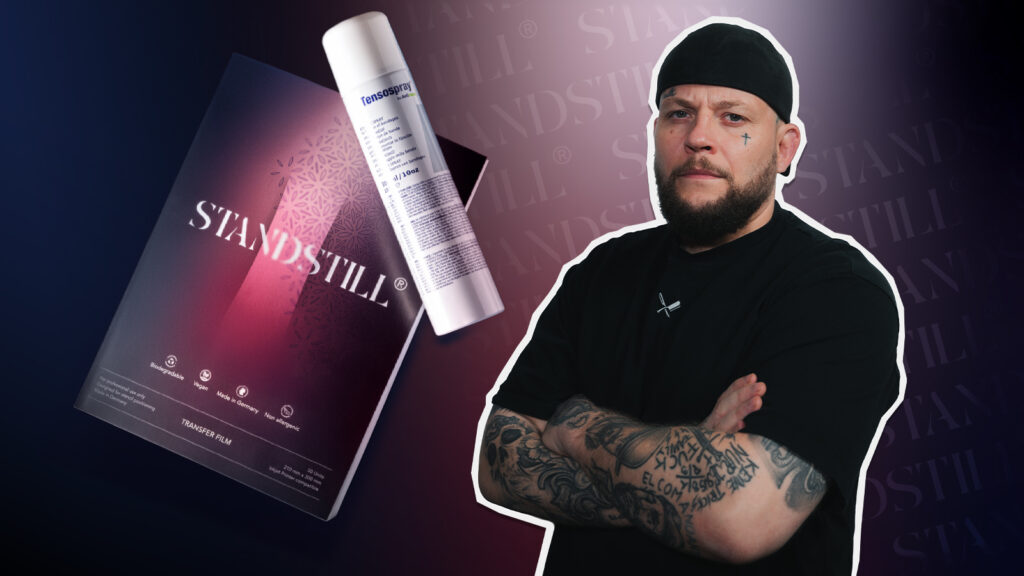
STANDSTILL is the new stencil transfer system, featuring a tattooable film and adhesive spray, that has been designed to make the lives of artists easier!
We had a chat with Phillip Trier, the founder and creator of the innovative stencil products, who gave us more insight into how the spray and film work together to take your stencil transfer game to the next level.
You can also watch the video below for an in-depth tutorial of how to use the system!
What first sparked the idea for STANDSTILL?
During my 18+ year tattooing journey, I found the projects I was working on continued to grow bigger, become more complex, and require a higher level of precision.
When using traditional thermal transfer paper and stencil fluid, I found there were limitations, including the mix of crumbling paper, smudging while printing, violet fingers, wet stencil fluid, difficulty cleaning the stencil after repositioning, and low visibility. It wasn’t perfect and I didn’t accept being confined by the materials I was using and this pushed me to find a way to overcome these limitations in my workflow.
How do the STANDSTILL Tattoo Transfer Film and Adhesive Spray work?
The STANDSTILL Transfer System is an alternative tool for transferring almost any design onto the skin, and using it as guidance for lining, dotwork, and ensuring the tattoo fits perfectly on the body. Each step of the transfer process becomes easier with the film and spray:
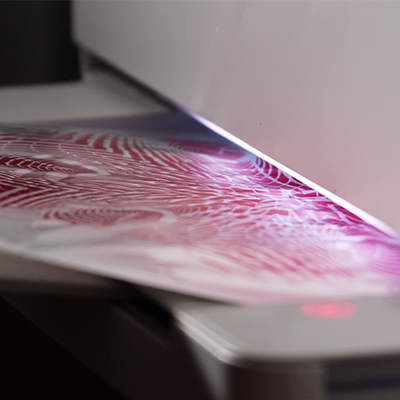
- Printing: No extra machine or special printer is needed. Common inkjet printers work perfectly with the compound sheet of transfer film and paper. You can also choose any colour to create the ideal contrast to your tattooing ink.
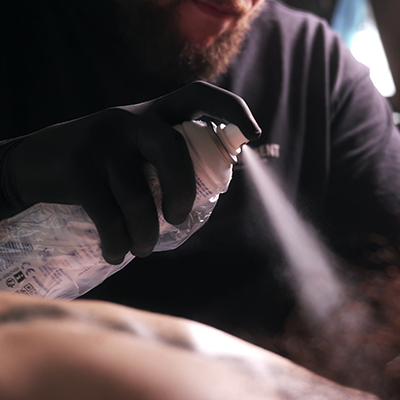
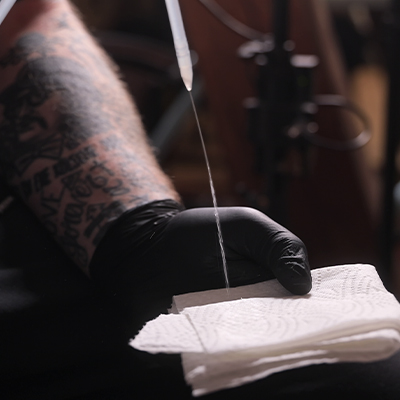
- Application: Disinfect the skin, spray layer of the skin adhesive, and place the STANDSTILL transfer film on the skin. Finally, spray a fine mist of disinfectant over the entire template, and once the film becomes soft and flexible, you are ready to tattoo.
- Tattooing: Using STANDSTILL requires a clean routine during tattooing. First apply ointment, then push or pull the line, set your dots, tattoo the waterline, or mark your fundamental contours. Excess ink will remain on the film, which is protected by the ointment or Vaseline, but you can easily dab the ink away with a paper towel. Repeat until the concept is secured on the skin.
- Removing the film: When you’re finished, wet a paper towel. For large-scale templates, use several wet paper towels to clean the skin from the film and adhesive. To remove any remaining residue from the skin adhesive, use a small amount of clean skin oil.
- Final steps: With the lined, dotted, or contoured concept on the skin, you can now start shading, colouring, and filling to complete the tattoo.
What did you consider the most essential aspect for STANDSTILL to embody? Was the goal efficiency, precision, hygiene, or a balance of all of them?
A balance of all of them, because I instantly realised the potential and the wide range of possibilities this transfer system offers. For precision, you can reposition without cleaning, see-through the film to align the design correctly on body midpoints or movable body parts, as well as accurately place extensions of large-scale tattoos, and background applications without smudging or fading.
The ability to mirror the template on demand, to produce it in any colour, and especially to use high-definition, fully shaded versions is a game-changing for efficiency in tattooing. You don’t have to rush anymore trying to catch the perfect moment when the stencil fluid is the right consistency on the skin. STANDSTILL is always sticky and attachable.
There are so many attributes worth mentioning, the hygiene and safety of the product being one of them. The products are biodegradable and organic as well as hypoallergenic and vegan.
The name STANDSTILL feels very intentional. What’s the meaning behind it, and how does it represent the product’s purpose?
The name ‘STANDSTILL’ echoes the word ‘stencil’. It also carries the idea of something clean, stable, grounded and strong, a steady guidance for the template.
You developed and tested the stencil products with artists who have 15+ years in the tattoo industry. How was it to collaborate with others on a project like this?
The invention and the entire functional workflow are based on my idea and research. However, after I established the first test version of the STANDSTILL transfer system, I was fortunate enough to have a very skilled team of seven tattooers by my side, as well as many open-minded artists in my circle of friends who were ready to use it, test it, and give me feedback. All of them were unique in their work, which allowed me to test the usability and multi-compatibility across large-scale blackwork, full colour, geometric styles, illustrative work, and fine line designs.
Everyone was excited, and still is, to use the new tool and its advantages. We are all glad that progress is still possible in the tattoo industry, even after decades of using only one method. There is much more to come.
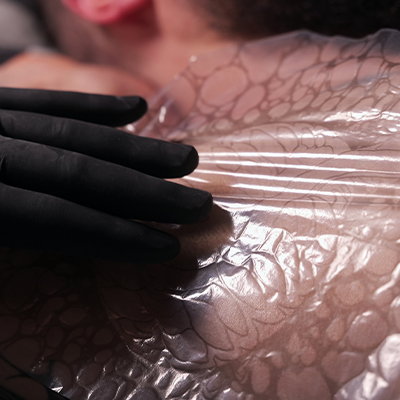
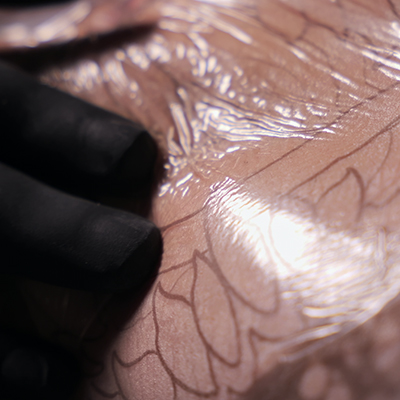
How did you choose a material that’s flexible enough for the transfer film to work well on tricky spots like joints?
When choosing a material, I wanted to make sure that three major attributes were fulfilled:
- Skin-friendly material
- Water-soluble and biodegradable properties
- Ultra-thin, see-through, and flexible structure
How does STANDSTILL specifically solve problems with wraparounds, full-backs, and big concepts?
STANDSTILL is a great solution for ensuring accuracy in wraparounds and big concepts. For large-scale concepts, you can now tattoo sheet after sheet. You no longer have to wrap a huge, taped-together stencil around the body part. Once you have printed the correct size, you apply the film to the central, relevant area first, tattoo it, secure it on the skin, and then apply extension sheet after extension sheet.
Wraparounds and cover-ups are also much easier to place. The amount of tattooing time gained by being faster with tricky placements gives you the opportunity to work calmer and more thoroughly, because you didn’t lose any time on multiple positioning attempts.
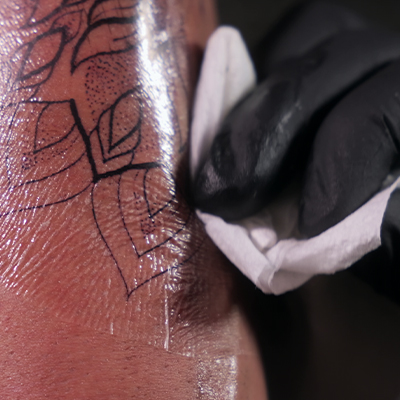
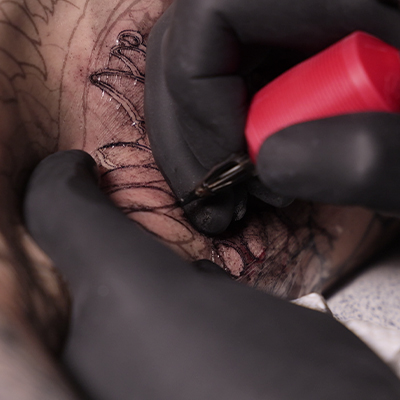
Tattooing directly through a water-soluble film is a completely new concept for many artists. How did you fine-tune the film so it breaks and dissolves naturally as you tattoo?
That happened through testing. I tried various versions of the film, from thick to ultra-thin, and eventually found the best balance. Now, there isn’t much difference between tattooing through the soft STANDSTILL film or a layer of Vaseline, which most of us are already familiar with. There is an element of adapting to something new and you might need a bit of effort and patience to get used to the material but once you do, it’s great.
You designed the adhesive specifically to pair with the film. What makes this pairing different from using other stencil sprays?
The differences are huge: every single application is free from smudging. Once you spray a layer of skin adhesive and apply the STANDSTILL film, it keeps the design fixed on the skin where it belongs and when you stretch the skin, it bends with the same flexibility and stays in place.
Many artists say the biggest issue with stencils is distortion on moving body parts. How does the spray address that?
It’s not the spray alone that solves this problem. It’s the combination of the STANDSTILL film being flexible and see-through, and the body area being well covered with the spray adhesive. With this combination, the design will remain undistorted and “standstill” on the skin.
The zero-waste approach, i.e. reusable backing paper and dissolvable film, is unique in the industry. Was sustainability a goal from the start or something that evolved during development?
Sustainability was a goal from the beginning and I wanted the film to be biodegradable and help reduce waste as well as be body-compatible, highly efficient, and versatile.
Both the spray and film are made with vegan, hypoallergenic, and skin neutral ingredients. Did you encounter any obstacles sourcing skin-neutral materials that still performed at a high level?
Yes, it was tricky, but I dedicated all of my time, competence, and connections to finding producers in the medical field, communicating my ideas as well as the requirements it must fulfill, and the no-go’s.
You’ve had many well-known artists test the system. What are some of the most surprising or memorable reactions you’ve received so far?
I think the most memorable reaction from every artist was the fascinated laughter when seeing the film disappear, revealing the tattoo underneath. In that moment, it becomes clear that there is an alternative method that offers completely new possibilities in many ways. They’re also impressed by how precise the workflow becomes when positioning tricky placements and movable body parts as well as the time-saving benefit.
Is there a feature that artists consistently say is their favourite, something they didn’t expect to love as much as they do?
Timesaving and precision. I noticed, especially within my team, that once they use conventional paper again, they are genuinely surprised by how complex the workflow is.
For artists who specialise in fineline, realism, dotwork, or full illustrations, what advantages does the STANDSTILL system bring to these styles specifically?
- Fineline: The quick, repositionable aspect of STANDSTILL and the ability to adjust the placement very precisely in combination with existing tattoos is great. The high-definition lines on the film are also a real development for projecting concepts onto the skin.
- Realism: Realistic tattoos normally require an extra drawing step to map shading and details. STANDSTILL lets you place the full portrait or image directly on the skin as a shaded or coloured preview, then lightly tattoo it as a lasting stencil. This keeps the design accurate, lets you pause and resume sessions easily, and allows clean extensions or background work without staining fresh colours.
- Dotwork: STANDSTILL excels in dotwork and geometric tattoo designs. Perfect placement, symmetrical arrangements, and templates with very small details can be applied without smudging or melting together. It also helps you find the center of a joint or the precise position within expanded patterns.
- Illustrative: Having the ability to transfer an ultra-precise linework version of your illustration and adjust the placement within seconds is highly advantageous. The option to project your concept in any colour, from bright and light to dark and saturated, is another benefit. In stencil areas like small faces or hands, complex hair structures, or fine textures, there will be no smudging or melting of lines.
Looking ahead, are there any additions, new products, or further innovations you envision building around the STANDSTILL system?
Yes. We are currently working on STANDSTILL Film 2.0, a new solution for fixation and a great invention that helps keep the artist’s focus constantly on the artwork. We are developing tools that offer alternative and better solutions. I am committed to helping myself, my team, and my colleagues reach higher quality, provide more options, new ideas, new horizons, and expand creativity. So, you can be sure: more is coming.